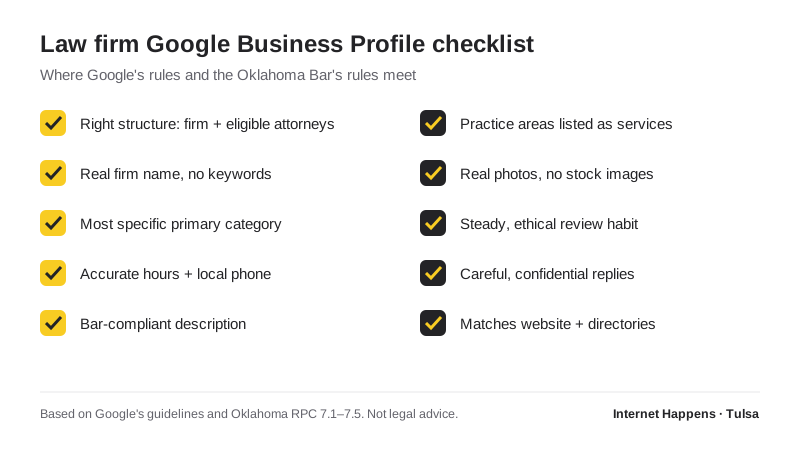
The short version: For many law firms, the Google Business Profile does more to win new clients than the website does -- it's what people see in the map results when they search for a lawyer nearby. Get the structure right (firm profile, and attorney profiles only where Google's rules allow), choose the most specific category, write a description that's accurate enough for the Bar, build a steady and ethical review habit, and keep everything consistent with your website.
When someone searches "family law attorney Tulsa" or "car accident lawyer near me," the first thing they usually see isn't a website. It's a map with three law firms beneath it, each showing a star rating, a review count, hours, and a phone button. A lot of people call straight from that map without ever visiting a website.
In Legal Marketing 101, I called the Google Business Profile the single highest-leverage piece of legal marketing that gets neglected. After years of working with the Tulsa Bar Association and dozens of Oklahoma law firms, I still believe that. Here's how to set one up properly -- including the parts where Google's rules and the Oklahoma Bar's rules overlap.
1. Get the Structure Right: Firm vs. Attorney Profiles
Google's guidelines for representing your business specifically allow separate profiles for individual practitioners -- and lawyers are one of the examples Google gives. An attorney is eligible for their own profile if they're in a public-facing role and can be contacted directly at the verified location during stated hours. Support staff aren't eligible.
- Multi-attorney firms can have a profile for the firm's location and separate profiles for eligible attorneys at that location. The attorney profile should use the attorney's name (with a credential like "Esq." or "JD" if you like), not the firm name.
- Solo practitioners at a branded firm are different. If you're the only public-facing lawyer at that location, Google's guidelines call for a single profile rather than separate firm and attorney profiles competing with each other.
- Multiple offices each get their own firm profile -- but only real offices with staff and signage. Google doesn't allow profiles for virtual offices or locations where you don't actually serve clients during stated hours.
Getting this wrong causes two problems: duplicate profiles competing against each other in search, and profiles that get suspended for violating the guidelines.
2. Use Your Real Firm Name -- No Keywords
"Smith Law" is a firm name. "Smith Law | Tulsa Car Accident & Injury Lawyers" is a firm name with keywords stuffed into it, and it violates Google's guidelines. It may work for a while. It's also one of the most common reasons law firm profiles get suspended, and competitors can report it.
There's a Bar angle here too. Under Rule 7.5 of the Oklahoma Rules of Professional Conduct, firm names and professional designations can't be false or misleading. I walk through how that and the other advertising rules apply online in Oklahoma Attorney Advertising Rules for Law Firm Websites.
3. Choose the Most Specific Category
Your primary category is one of the strongest signals Google uses to decide which searches you appear for. Google asks you to pick the category that describes what your business is, as specifically as possible. For a firm that focuses on personal injury, "Personal injury attorney" beats a generic "Law firm." Family law, criminal defense, estate planning, bankruptcy, and employment law all have specific categories too.
Add secondary categories only for practice areas you genuinely handle. Adding categories for work you rarely do can dilute your relevance for the work you want.
4. Write a Description That's Accurate Enough for the Bar
The business description is a short space to explain what your firm does, who you help, and where. Treat it like any other lawyer advertising, because it is:
- Describe practice areas as what you "focus on" or "concentrate in" -- be cautious with "specialist" and "specializing" under Rule 7.4.
- Skip unverifiable superlatives like "best" or "top-rated."
- Don't promise outcomes, and be careful with "no fee" language unless the costs picture is clear.
- Mention the communities you actually serve -- Tulsa, Broken Arrow, Owasso, and so on -- in natural sentences.
5. Fill Out Everything Else
- Services: list each practice area, with a short, plain-English description.
- Hours: accurate regular hours, plus special hours for holidays. If you take calls after hours, say so on your website and make sure someone actually answers.
- Phone number: a local number that matches your website. If you use call tracking, set it up carefully -- I explain how in how to track phone calls from your website.
- Website link: point it to your homepage or the specific location page for multi-office firms.
- Photos: real photos of your attorneys, your office exterior and signage (which helps people find you), and your interior. Skip stock photos entirely -- they add nothing and can imply things that aren't true about your firm.
- Posts: occasional updates about firm news, community involvement, or helpful legal information keep the profile active.
6. Build a Steady, Ethical Review Habit
Reviews are where law firm profiles are won and lost. Two firms with similar credentials can sit side by side in the map results, and the one with more recent, detailed reviews usually gets the call. Recency matters as much as volume -- 50 reviews from five years ago look worse than 20 from the past year.
The rules are strict, and they come from two directions:
- Google prohibits offering incentives in exchange for reviews and doesn't allow selectively asking only happy clients (sometimes called "review gating").
- The Bar prohibits giving something of value for recommending your services, and client confidentiality applies to everything you say publicly.
The approach that works within both: ask every client at the natural end of the matter, with a direct link, and nothing attached. Make it part of your closing process so it happens consistently rather than in occasional bursts.
Responding to reviews
Reply to reviews -- it shows prospective clients you're engaged. But be careful: responding in a way that confirms someone was a client or discusses their matter can raise confidentiality issues. The ABA's Formal Opinion 496 addresses negative online reviews specifically. A short, professional reply that doesn't confirm details ("We take all feedback seriously and invite you to contact our office directly") is almost always the safer path. For a specific situation, the OBA's Ethics Counsel is a confidential resource for members.
7. Keep It Consistent With Everything Else
Your profile doesn't work in isolation. Google -- and increasingly AI tools like ChatGPT and Google's AI Overviews -- cross-check your name, address, phone number, hours, and practice areas against your website and directory listings. When they match, you're trustworthy. When they don't, you lose ground. If you want to see what AI tools currently say about your firm, run through this 30-minute self-audit.
Where to Start
If your firm's profile hasn't had attention in a while, start with three things this week: confirm your name and category are correct, update your hours and photos, and set up a simple, consistent way to ask every client for a review. Those three changes often produce the fastest visible improvement of anything in legal marketing.
For firms that want help -- from someone who understands both Google's rules and the Bar's -- Google Business Profile management is a core part of my Tulsa law firm marketing work. And for local businesses outside the legal field, my general Google Business Profile guide covers the essentials.