The short version: llms.txt is a plain-text file you can put at the root of your website to give AI tools a short, curated summary of who you are and which pages matter most. It was proposed in 2024 and is not an official standard. Google says you don't need it to appear in its AI features, and major AI providers haven't confirmed they rely on it. It's cheap and harmless to add, so I have one -- but if someone is charging you real money for it or calling it an "AI strategy," walk away.
Every new technology produces at least one thing that gets oversold. In AI search right now, that thing is llms.txt. I've seen it pitched as the secret to getting recommended by ChatGPT, bundled into expensive "AI readiness" packages, and dismissed as useless. The truth sits in the boring middle, which is exactly why it's worth explaining carefully.
What llms.txt Actually Is
llms.txt is a proposal published in September 2024 by Jeremy Howard of Answer.AI, with a companion specification at llmstxt.org. The idea addresses a real problem: websites are full of navigation, scripts, cookie banners, and layout code, which makes it harder for a large language model to find the parts that actually matter. The proposal suggests a single Markdown file at yourwebsite.com/llms.txt that gives AI tools a compact summary and a curated list of your most important pages.
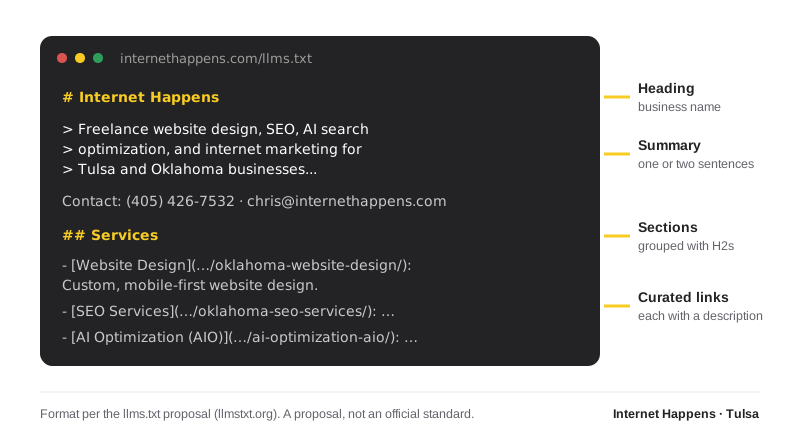
The format is simple: your business name as a heading, a one- or two-sentence summary, a little context, and then sections of links with short descriptions. Here's the top of the one on this site:
What llms.txt Is Not
Most of the confusion comes from what people assume the file does. So, to be clear:
- It's not a standard. It's a community proposal. No standards body has ratified it.
- It's not robots.txt. The names are similar, but robots.txt controls which crawlers can access your site. llms.txt controls nothing. Listing a page doesn't open it, and leaving a page out doesn't protect it. If you want to manage AI crawler access, that's robots.txt -- I cover the important crawlers in my AI visibility self-audit.
- It's not required by Google. Google's own guidance on AI features says you don't need to create new machine-readable files or AI text files to appear in AI Overviews or AI Mode. Normal SEO best practices apply.
- It's not a confirmed ranking signal anywhere. As of early 2026, none of the major AI providers had publicly confirmed that their search or retrieval systems use it.
So Why Do I Have One?
Three reasons, in order of how much they actually matter:
- It costs almost nothing. On my site, the file rebuilds itself automatically whenever a new article publishes, so it's always current. For most businesses, it's a one-time job of an hour or less.
- Some tools do read it. AI coding assistants and agent-style tools that browse the web on someone's behalf can use it as a clean map of a site. That audience may grow.
- Writing it is a useful exercise. Being forced to describe your business in two sentences and choose your ten most important pages is clarifying. If you struggle to write your llms.txt, your homepage probably has the same problem.
It also helped my site score well on some of the newer agent-readiness checks in Google's Lighthouse tool, which I talk about in why I moved my own site off WordPress. But I'd never tell a client that a good score on a checklist means customers will find them.
How to Create One
If you want to add llms.txt to your site, here's the straightforward version:
- Start with a heading and summary. Your business name as an H1 (
# Your Business), then a one-sentence summary on a line starting with>. Say what you do, for whom, and where. - Add a short paragraph of context. Who runs the business, what makes it different, how to contact you.
- Group your key pages under H2 headings. Services, locations, resources, about and contact. Each line is a Markdown link followed by a short description.
- Keep it curated. This isn't a sitemap. Include the pages that genuinely explain your business -- typically 10 to 40 links for a small business.
- Save it as plain text named
llms.txtand upload it to the root of your website, the same place your robots.txt lives. - Keep it accurate. An outdated llms.txt is worse than none. If your services, phone number, or pages change, update it -- or have it generated automatically.
Consistency matters more than the file. Whatever your llms.txt says -- business name, services, phone number, service area -- should match your website, your Google Business Profile, and your directory listings exactly. AI tools cross-check what the web says about you, and contradictions are how they end up confidently wrong.
What to Focus on Instead
If you're trying to show up in AI search, llms.txt is the garnish, not the meal. The things that actually move the needle are the same fundamentals I describe in AIO vs. GEO vs. SEO: a crawlable, fast website; clear, answer-first content; accurate and consistent business information; genuine reviews; and credible mentions of your business around the web.
If you'd like help with the parts that matter -- with an llms.txt set up along the way -- take a look at my AI Optimization services.