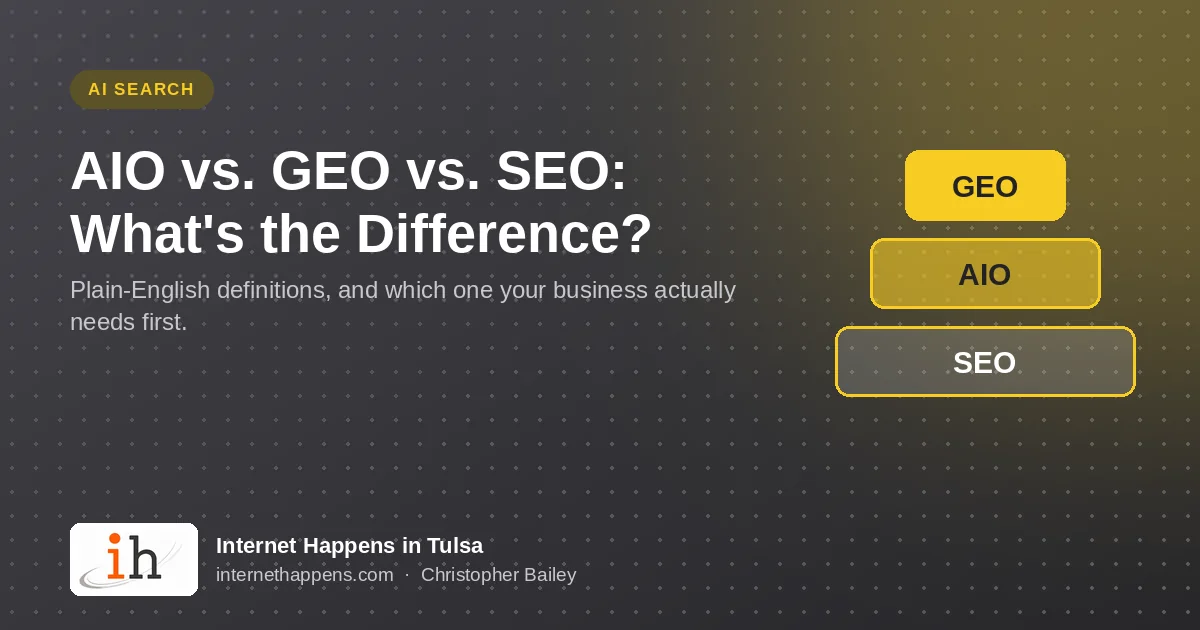
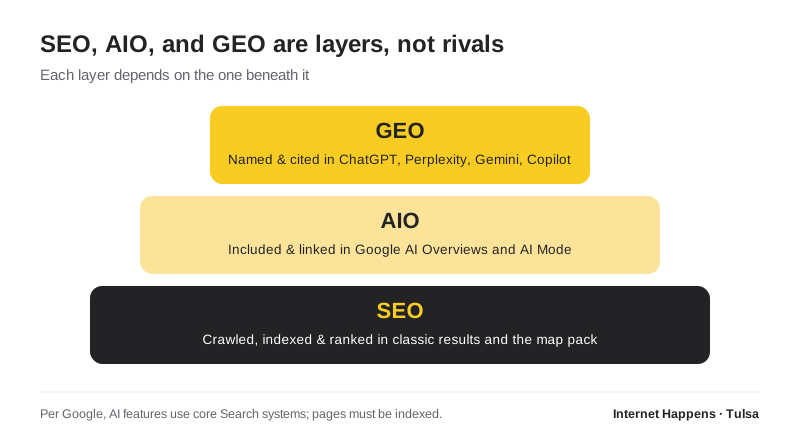
The short version: SEO gets you found in regular Google results and the map pack. AIO (AI Optimization) gets you included in Google's AI Overviews and AI Mode. GEO (Generative Engine Optimization) gets your business named and cited in answers from ChatGPT, Perplexity, Gemini, and Copilot. They aren't competing strategies -- they're layers, and each one depends on the one beneath it. Start with SEO.
Every few years, marketing invents a new acronym and a new invoice line to go with it. So I understand the skepticism when a business owner asks me whether AIO and GEO are real or just SEO with a fresh coat of paint.
The honest answer: they're real, they overlap heavily with SEO, and the differences are worth understanding -- because the way people search really has changed. Here's how I explain it to clients, without the jargon.
First, a Quick Note on the Acronyms
The industry hasn't settled on standard terms, which doesn't help. You'll see "AIO" used for "AI Optimization" (how I use it) and occasionally as shorthand for Google's AI Overviews themselves. You'll also see "AEO" (Answer Engine Optimization) and "LLMO" (Large Language Model Optimization) floating around. They're all describing overlapping ideas. On this site, and in this article:
- SEO = visibility in classic search results and Google Maps.
- AIO = visibility inside Google's AI-generated results (AI Overviews and AI Mode).
- GEO = being named and cited by standalone AI assistants like ChatGPT and Perplexity.
SEO: The Foundation Everything Else Sits On
Search engine optimization is the work of making your site crawlable, fast, relevant, and trustworthy enough to rank -- in the blue links and, for local businesses, in the map pack. I go through what a legitimate SEO engagement looks like in my SEO explainer, so I won't repeat it all here.
The key point for this article: SEO isn't being replaced. It's being built on. AI search tools still retrieve information from indexed web pages. If your site can't be crawled, loads slowly, or doesn't clearly say what you do and where, no AI strategy will fix that.
AIO: Showing Up in Google's AI Results
Google's AI Overviews are the AI-written summaries that now appear above many search results. AI Mode is the more conversational, back-and-forth version for complex questions. Together they're where a growing share of Google searches start.
Here's what Google itself says in its guidance on AI features: the best practices for SEO still apply, and to appear as a supporting link a page must be indexed and eligible to show a snippet in Search. Google also describes a "query fan-out" technique, where its systems run multiple related searches across subtopics to build an answer.
That last detail is the practical key to AIO. If someone asks "how much does it cost to replace a roof in Tulsa," Google may also be searching for material types, insurance claims, hail damage, and timelines. A page that clearly answers the core question and the natural follow-ups gives Google more reasons to pull from it.
GEO: Getting Named by ChatGPT, Perplexity, and the Rest
Generative Engine Optimization is the newest of the three, and it actually started as academic research. A 2023 paper titled "GEO: Generative Engine Optimization" -- by researchers from Princeton, Georgia Tech, the Allen Institute for AI, and IIT Delhi, and later presented at the KDD 2024 conference -- tested what makes content more visible inside AI-generated answers. Their findings were practical: adding citations, quotations from relevant sources, and statistics improved source visibility by up to 40% in their benchmark, and by up to 37% in tests on Perplexity.
Two honest caveats. Those were controlled experiments, and the researchers found results varied significantly by topic. And AI assistants change constantly, so nobody -- including me -- can promise a specific result. But the direction is clear and sensible: specific, well-sourced, clearly written content is easier for AI to trust and quote.
GEO also reaches beyond your own website. When ChatGPT recommends a local business, it's drawing on what the wider web says: reviews, directory listings, news mentions, community discussions, and "best of" lists. That's why GEO work often looks a lot like good old-fashioned reputation building.
Why This Matters Now: The Click Problem
The reason business owners should care is simple. When AI answers the question on the results page, fewer people click through to websites.
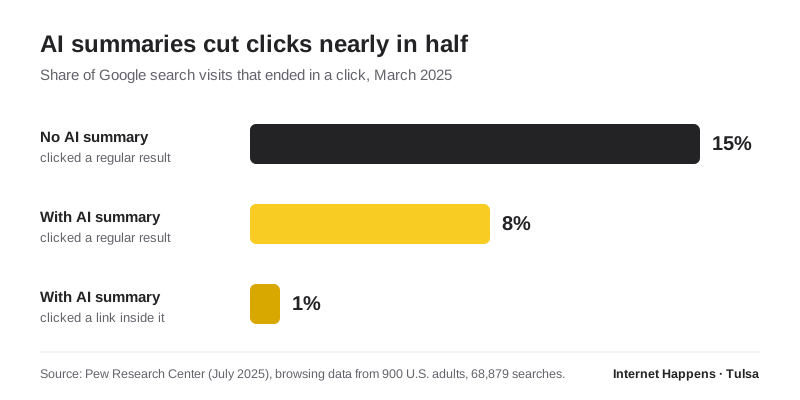
Pew Research Center's analysis found that users who saw an AI summary clicked a traditional result in 8% of visits, versus 15% when no summary appeared -- and clicked a link inside the summary itself in just 1% of visits. Pew also found that 58% of the people in its study ran at least one search that produced an AI summary during the month studied.
Meanwhile, standalone AI assistants keep growing. In a separate survey, Pew found that 34% of U.S. adults had used ChatGPT as of early 2025 -- roughly double the share in 2023 -- including 58% of adults under 30.
There's a flip side worth knowing. Google says that when people do click from a results page with an AI Overview, those clicks tend to be higher quality -- visitors are more likely to spend time on the site. Fewer clicks, but better ones, is a pattern I'd expect local businesses to see too.
Put those together and the takeaway is this: ranking is still necessary, but it's no longer the whole game. When the answer is written for the searcher, you want to be the business the answer names.
SEO vs. AIO vs. GEO at a Glance
| SEO | AIO | GEO | |
|---|---|---|---|
| Goal | Rank and earn the click | Be a source Google's AI draws from and links to | Be named or cited by AI assistants |
| Where it shows | Blue links, map pack | AI Overviews, AI Mode | ChatGPT, Perplexity, Gemini, Copilot |
| What you work on | Technical health, content, links, Google Business Profile | Question-focused content, clear structure, structured data | Citable facts, third-party mentions, reviews, consistent business info |
| How you measure it | Rankings, clicks, calls, Search Console | Search Console, spot-checking AI results | Manual prompt testing, AI referral traffic in analytics |
What Actually Works Across All Three
The good news is that most of the work overlaps. If I were starting from scratch with a local business, this is where the effort would go:
- Make sure the right crawlers can get in. Googlebot and Bingbot, obviously. If you want to appear in ChatGPT's search results, OpenAI says its OAI-SearchBot needs to be allowed -- sites that block it won't be shown in ChatGPT search answers. (OpenAI's separate GPTBot is for model training, and you can decide on it independently.)
- Get your business facts identical everywhere. Name, address, phone, hours, and services should match on your website, Google Business Profile, Bing Places, and major directories. Inconsistent facts are how AI ends up confidently wrong about you.
- Write answer-first content. Put the direct answer at the top of a section, then the detail. Use headings that match the questions customers actually ask.
- Cite and quantify. Reference credible sources, include real numbers where you have them, and share first-hand experience. It's what the GEO research rewarded, and it's what makes content trustworthy to humans anyway.
- Earn mentions beyond your own site. Reviews, local press, chamber and association listings, and genuine community participation all feed what AI "knows" about you.
- Use structured data honestly. Schema markup should describe what's actually on the page -- nothing more.
Red Flags to Watch For
Because this space is new, it's attracting the same kind of overpromising that SEO did fifteen years ago. Be cautious of anyone who:
- Guarantees placement in ChatGPT or AI Overviews. Nobody controls those systems, and answers vary from person to person and day to day.
- Sells a special "AI file" or schema as the fix. Google's guidance says plainly that you don't need new machine-readable files, AI text files, or special structured data to appear in its AI features. Files like llms.txt can be a reasonable extra, but they're not a strategy.
- Treats AIO or GEO as a replacement for SEO. Without the foundation, there's nothing for the AI layers to stand on.
Which One Does Your Business Need?
For most Oklahoma small businesses, the order is: get SEO and your Google Business Profile solid first, then shape your key pages for AI Overviews, then work on the broader mentions and citations that drive GEO. Skipping ahead rarely works.
If you want to see where you stand right now, I put together a 30-minute self-audit you can run on your own. And if you'd like help, you can read more about my AI Optimization (AIO) and Generative Engine Optimization (GEO) services -- built on the same SEO fundamentals I've been doing for Tulsa businesses for over 25 years.