Looking for the current version? This article was originally published on December 23, 2024. I've since written an up-to-date guide: Modern Website Design Techniques for 2026: What Actually Matters Now. Below is an honest look back at what the original 2025 list got right and wrong.
At the end of 2024, I published a list of ten modern website design techniques for 2025 -- responsive design, minimalism, typography, interactive elements, dark mode, performance, SEO and accessibility, AI and personalization, modern JavaScript frameworks, and security. Predictions are easy to make and easy to forget, so instead of quietly deleting the old post, I'd rather grade it. If you're deciding what to invest in on your own website, seeing what actually lasted is more useful than another trend list.
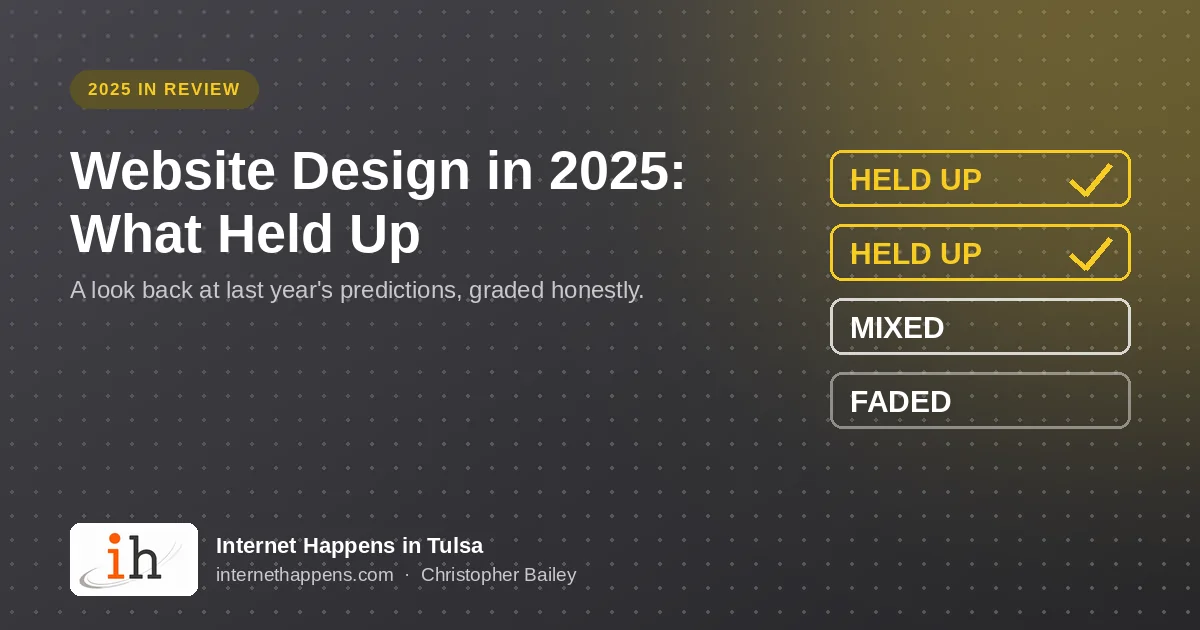
The Report Card
| 2025 technique | Grade | What actually happened |
|---|---|---|
| Responsive web design | Held up | Went from "best practice" to the bare minimum. Google indexes primarily from the mobile version of a site, so responsive isn't a feature anymore -- it's the website. |
| Minimalism and white space | Held up | Still right, for the same reason as before: fewer elements load faster and make the next step obvious. |
| Advanced typography and variable fonts | Held up | Variable fonts are routine now. The bigger lesson was loading fonts efficiently so text doesn't flash or shift while the page loads. |
| Parallax and interactive effects | Mixed | Subtle micro-interactions aged well. Heavy parallax did not -- it tends to hurt responsiveness scores and bothers visitors who are sensitive to motion. |
| Dark mode | Held up | Native CSS support makes it simple to respect a visitor's system setting. |
| Performance optimization | Held up, and got stricter | Interaction to Next Paint (INP) replaced First Input Delay as a Core Web Vital in March 2024, and it's a tougher test. Speed matters more than the original post suggested. |
| SEO and accessibility | Bigger than predicted | WCAG 2.2 is current, and the DOJ adopted WCAG 2.1 AA as the standard for government websites under ADA Title II. Accessibility deserved its own section, not half of one. |
| AI and personalization | Right topic, wrong angle | AI didn't mainly change how small business sites look. It changed how customers find them -- through AI Overviews, ChatGPT, and Perplexity. That's the real story of 2025. |
| Modern JavaScript frameworks and PWAs | Faded for small business | Great tools for web applications. For a local service business site, fast server-rendered HTML with minimal JavaScript usually wins. |
| Security and privacy | Held up | HTTPS, regular updates, and fewer plugins are still the foundation. Nothing about that has changed. |
What I'd Tell Myself in December 2024
Three things. First, the fundamentals were more important than the trends -- speed, accessibility, and clear content outlasted every flashy technique on the list. Second, I underestimated how quickly search would change. The question for 2026 isn't only "does my website look modern?" but "can Google's AI and ChatGPT understand what my business does, where, and for whom?" Third, simpler builds age better. The sites that held up best over the past year were the ones carrying the least weight.
That thinking is what shaped the current guide. If you're planning a redesign or just want to know where your site stands, start with Modern Website Design Techniques for 2026 -- it includes a practical checklist you can run on your own site in about fifteen minutes.
And if you'd rather have a second set of eyes on it, that's what I do through my Tulsa website design work -- directly with you, no agency layers in between.